
Palawod Festival: The Heart of Bantayan Island's Fishing Traditions
The Palawod Festival is Bantayan Island’s annual celebration of its fishing heritage, held every June 29 in the municipality of Bantayan, Cebu, Philippines. The festival coincides with the feast of Sts. Peter and Paul, the town’s patron saints, and takes its name from the Cebuano word meaning “to go out to the open sea.”
Founded in 2001, Palawod is a street dancing and cultural festival that honors the daily life of the island’s fisherfolk through four traditional dance steps, the sound of the budyong, and the rhythms of the sea.
The budyong sounds first. That long, low note from a conch shell carries across the plaza before the dancers even appear, and something in your chest drops a little, like the island itself is exhaling.
Then the drums come in, and the street fills with color: shell skirts catching the late-morning light, giant clam headdresses swaying, and a hundred feet moving together in the heavy, deliberate rhythm of people who know what it means to work the sea. This is June 29 in Bantayan town, and this is Palawod.
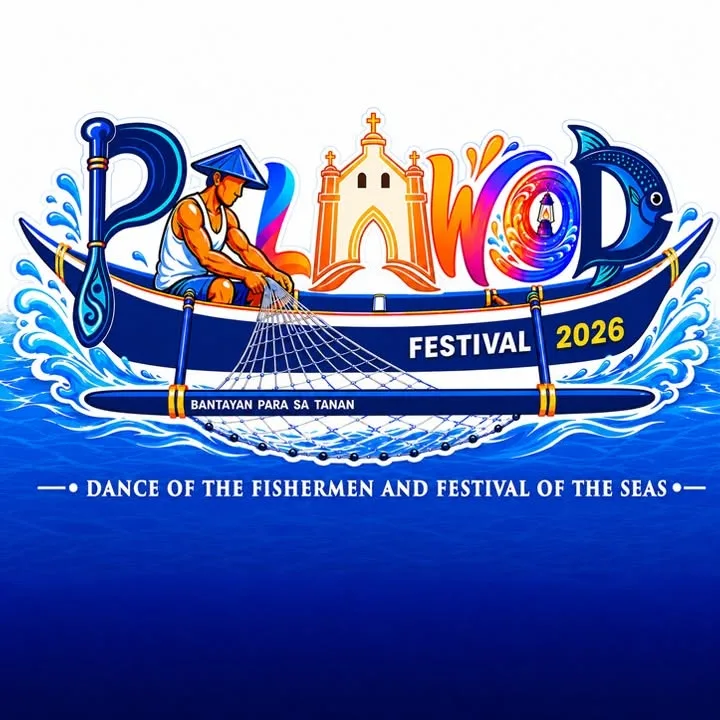
The Meaning Behind the Palawod Festival
The word palawod comes from lawod, meaning “open sea,” and the full term refers to going out to the open sea to fish. In my experience listening to older Bantayanons describe their fathers’ and grandfathers’ mornings, the word carries more weight than a dictionary can hold.
It is the pre-dawn walk to the bangka. It is the smell of diesel and brine. It is the particular faith required to point a small boat toward open water and expect to come back with something.
The name also traces to the Latin phrase Duc In Altum from Luke 5:4, meaning “into the deep,” and this connection was intentional on the part of the festival’s founders, who wanted to honor a fishing culture rather than simply stage a performance.
The festival falls on June 29 each year because this is the feast day of Sts. Peter and Paul, the town’s patron saints. The choice is not incidental. Peter and Paul were fishermen before they were apostles, and Bantayanons have always read their own lives in that story.
The annual fiesta and the festival do not compete with each other. They are the same thing: a fishing community pausing to say thank you for what the sea provides.
Setting the Record Straight: The Holy Week Misconception
For years, a misunderstanding followed Bantayan around. Many people outside the island associated its Holy Week gatherings with the town fiesta, assuming the feasting and the crowds meant that Good Friday was the big celebration. It was not. Bantayan’s official fiesta has always been June 29, in honor of Sts. Peter and Paul.
One of the cultural purposes Palawod served, as documented by researcher Nepangue (2024), was to help correct this confusion. By building a vibrant, visible public celebration on June 29 every year, the festival reminded both the community and outside visitors where the town’s actual feast day falls.
Beyond being a celebration of dance and creativity, Palawod became a cultural platform for preserving Bantayan’s history, strengthening local identity, and honoring the faith and livelihood of the Bantayanon people. Through its symbols of the sea, the fisherman, the boat, and the devotion to Sts. Peter and Paul, Palawod continues to tell the story of a community shaped by faith, heritage, and the life of the water.
The Budyong: More Than a Shell
Before the first dancer steps onto the street, you hear the budyong. That low, resonant call from a conch shell is the sound that opens the festival, and it is not decorative.
In the older life of the island, the budyong was a working instrument. Fishermen used it to signal other boats, to call people together, and to warn the community when something was wrong. It carried across the water in a way a voice could not.
As documented by Nepangue (2024), the budyong was historically used to gather the community and alert people to possible danger, and it was deliberately woven into the Palawod music as a reminder of that role.
When you hear it during the festival, you are not hearing a stage effect. You are hearing the island’s old way of speaking to itself.
A Legacy of Faith and Harvest: History of the Palawod Festival
The Palawod Festival was founded in 2001 by then-tourism officer Vince Escario, working with a team that included John Ray Pagalan, Junie Tampus, and Patricio Junjet E. Primor Jr., along with the Synchronous Dancers. It was formally established under the leadership of Mayor Geralyn Escario Canares and Vice-Mayor Remedios A. Escario.
The founding team had a specific problem to solve. Research on the festival shows it was created to build a social event that could stand alongside, or even surpass, the Holy Week celebration, and also to address the widespread belief outside the island that Good Friday in Bantayan was simply a party. The founders wanted to give Bantayanons a celebration that was entirely their own.
It worked. The festival holds the distinction of winning the Pasigarbo sa Sugbo Festival of Festivals competition three times, earning attention at both national and international levels. Bantayan took the inaugural championship in 2008, defended it in 2009, and won a third consecutive title in 2010.
Locals who were children during those early championship years still talk about it the way people talk about a good year at sea. One older vendor near the church told me once that those wins changed how people outside Cebu thought about the island. “Hindi lang kami isda,” she said. We are not just fish.
The festival is also inseparable from the church that anchors the town. The Augustinians established the Saints Peter and Paul Parish in Bantayan on June 11, 1580, making it the first and oldest parish created in Cebu. When you stand inside that old stone structure on the morning of June 29, with the Mass just ending and the dancers preparing outside, the connection between devotion and livelihood feels very clear.
What to Expect: Palawod Festival 2026 Activities and Rituals
The street dancing is the center of everything, but it is not exactly what a visitor expecting a Sinulog-style spectacle might picture. It is slower in places, more deliberate, and the movements are doing real storytelling.
The Four Basic Steps of the Palawod Dance
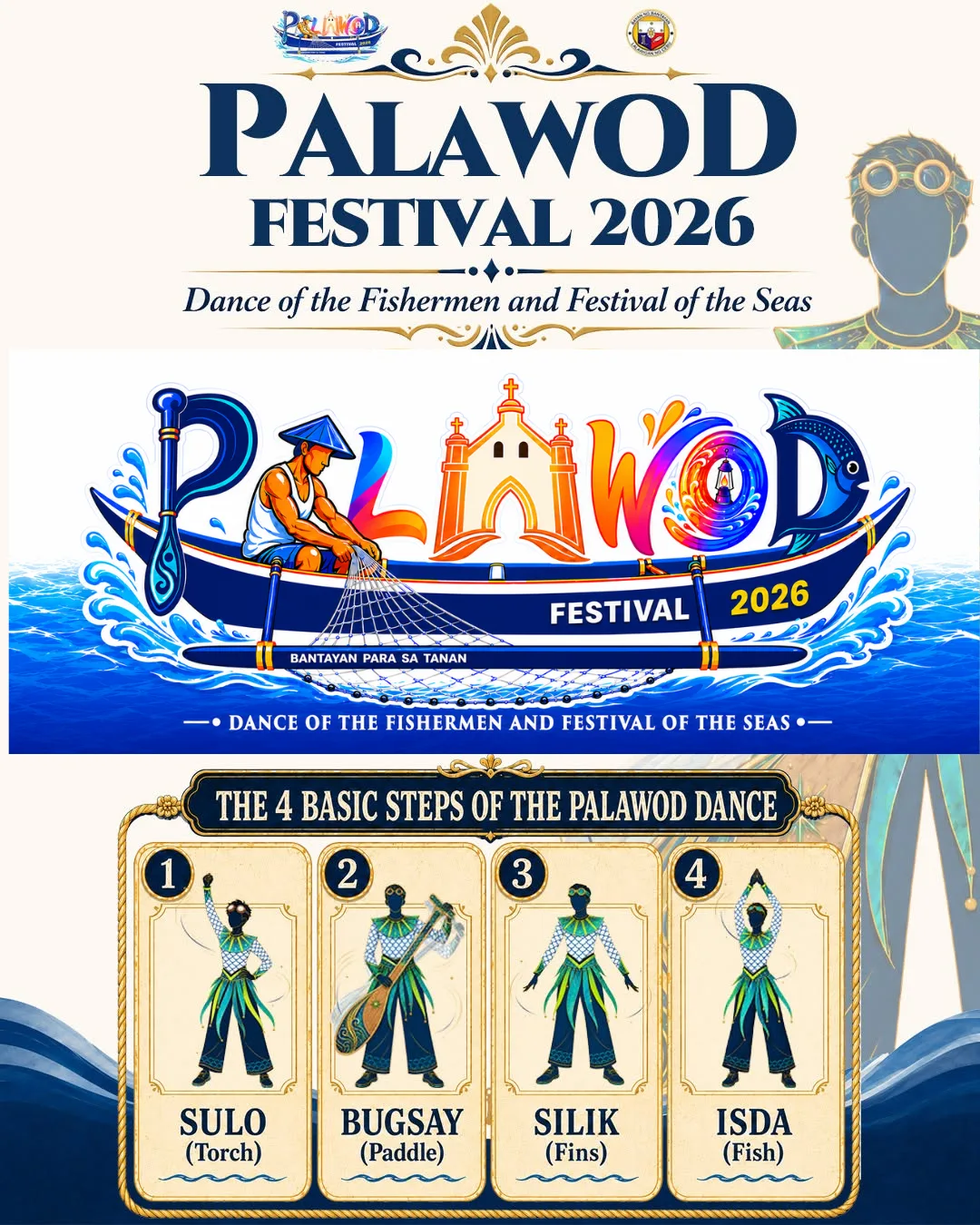
Sulo (Torch) captures the motion of holding and waving a torch at sea, the way a fisherman signals or lights his work during a night catch. It is the step that carries arms highest, and when a hundred dancers do it together, the effect is something close to fire moving across water. The Sulo is a symbol of light, guidance, and hope.
Bugsay (Paddle) is the one to watch if you want to understand where the choreography comes from. Dancers hold imaginary paddles and pull through the air in the exact wide arc a fisherman uses to turn a bangka against the current. The movement is in the shoulders and the torso, not just the arms. It represents effort, endurance, and a fisherman’s determination to find the catch that feeds his family.
Silik (Fins) is the most fluid of the four. It ripples through the body laterally, mimicking the flex of a fish changing direction underwater. When executed well, you see the water in it. It reflects the abundance and diversity of sea life that has sustained Bantayan for generations.
Isda (Fish) closes the set with a gesture that mimics fish swimming and, at times, breaking the surface. It is a step of thanksgiving, representing the sea’s generosity and the central place fish hold in Bantayanon life.
These four steps, Sulo, Bugsay, Silik, and Isda, are the foundation of the Palawod Dance and express the faith, livelihood, and pride of the Bantayanon people.
The Seven Contingents of Palawod Festival 2026
Palawod Festival 2026 carries the theme “Dance of the Fishermen and Festival of the Seas” and the tagline “Pito ka Hugpong. Usa ka Dagat. Usa ka Garbo sa Bantayan”: Seven groups. One sea. One pride of Bantayan.
For 2026, barangays perform in seven waves, in the following order:
Dance of the Fishermen · Festival of the Seas
Palawod Festival 2026
Contingents · In Order of Performance
Pito ka Hugpong. Usa ka Dagat. Usa ka Garbo sa Bantayan.
- Patao
- Kabac
- Baod
- Putian
- Sulangan
- Oboob
- Sungko
- Bantigue
- Guiwanon
- Kampingganon
- Kabangbang
- Binaobao
- Ticad
- Suba
- AtopAtop
- Kangkaibe
- Tamiao
- Doong
- Luyongbaybay
- Hilotongan
- Lipayran
- Botigues
- Baigad
- Sillon
- Mojon
June 29, 2026 · Municipality of Bantayan · Bantayan Para sa Tanan
Visit: BantayanVibes.com →The musical accompaniment evolved over the years from live instruments to a recorded jingle featuring the kalatong and the budyong, set in a 4/4 time signature. That budyong call at the start of each performance is the one that catches visitors off guard. Locals recognize it immediately. It is the sound their fathers used to signal other boats at sea before modern radios arrived.
Costumes follow no strict standard, which is part of what makes each year’s iteration worth watching. There is no fixed requirement for costume, accessories, props, or footwear, as long as what is worn reflects Bantayan’s culture and history. In practice, this means the design team has wide latitude. Shell skirts, chipboard jellyfish, and headdresses shaped like giant clams have all appeared in past performances.
Local logistics tip: The street dancing along the main road typically runs from mid-morning. Arrive by 7:30 AM to find a spot with a clear sightline near the church plaza. Bring water. If you have children, find a position near one of the side streets where you can step back from the crowd when needed.
The New Look: The Palawod Festival 2026 Brand
The most visible sign that Palawod is actively tending to its identity is the 2026 logo, and it rewards a slow look.
Each letter in “PALAWOD” carries a specific meaning drawn from the island’s daily life. The P is shaped as a bugsay, a paddle, standing for pagpadayon, paningkamot, ug direksyon: perseverance, effort, and direction.
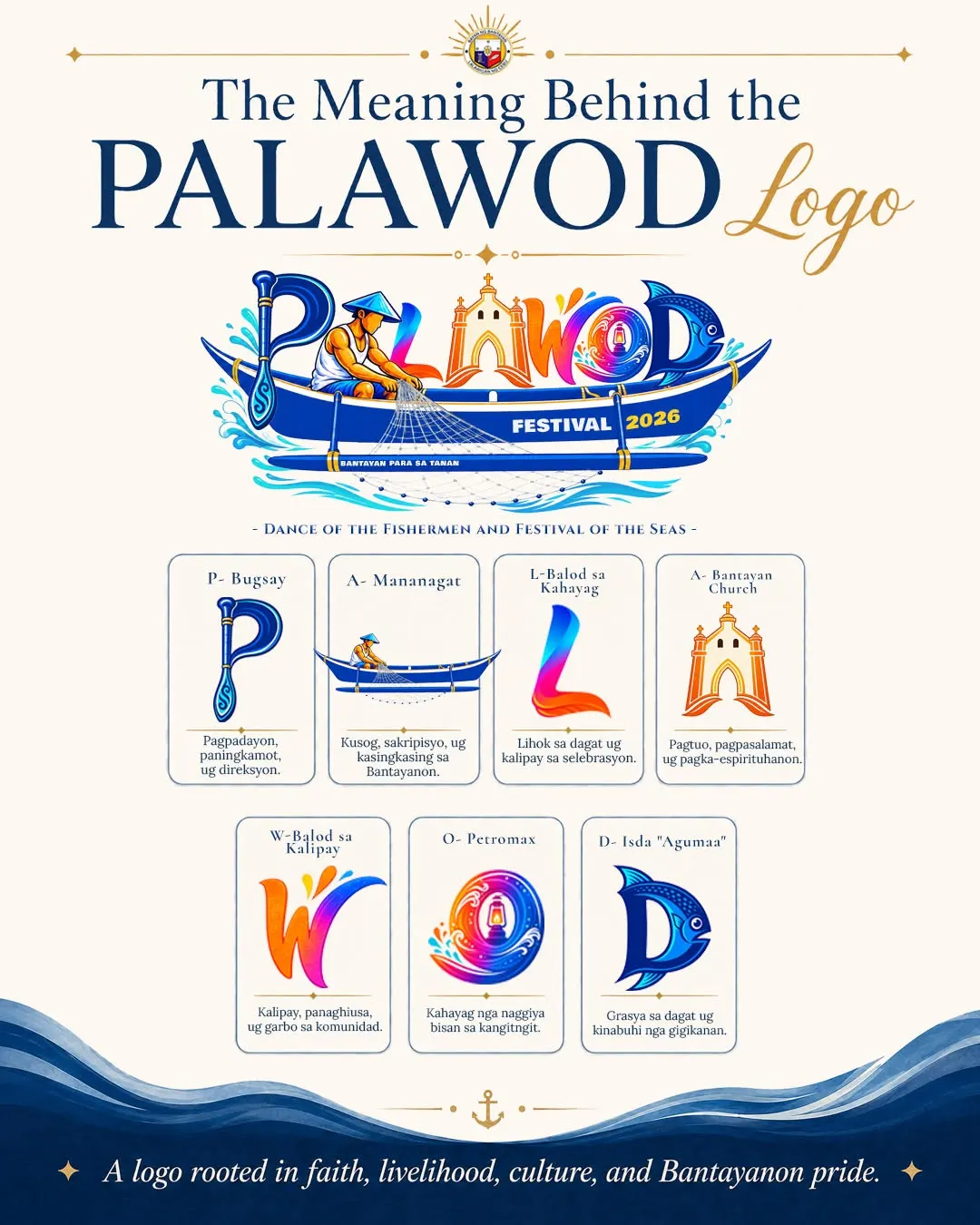
The A is a mananagat, a fisherman casting a net, representing kusog, sakripisyo, ug kasingkasing sa Bantayanon: the strength, sacrifice, and heart of the people.
The L is a balod sa kahayag, a wave of light, evoking lihok sa dagat ug kalipay sa selebrasyon: movement at sea and the joy of celebration.
The second A is the Bantayan Church itself, rendered in warm gold, for pagtuo, pagpasalamat, ug pagka-espirituhanon: faith, gratitude, and a spiritual life.
The W returns to the waves, a balod sa kalipay, expressing kalipay, panaghiusa, ug garbo sa komunidad: joy, unity, and community pride.
The O is a Petromax lamp, a kahayag nga naggiya bisan sa kangitngit, a light that guides even in the dark, which anyone who has been out on the water at night will understand as more than poetic.
The D closes the word as isda “agumaa”, a fish, for grasya sa dagat ug kinabuhi nga gigikanan: the grace of the sea and the source of life.
Set in a blue bangka on open water, with the tagline “Dance of the Fishermen and Festival of the Seas” and the phrase Bantayan Para sa Tanan written along the hull, the full logo lands as a mission statement as much as a visual identity. Every element earns its place.
The 2026 branding also matters as context. With Pasigarbo sa Sugbo’s future uncertain following the 2025 cancellation announcement by Cebu Governor Pam Baricuatro, who planned to redirect those funds toward healthcare, poverty reduction, and essential services, Bantayan did not wait to see what happens to the competition.
They built a logo and a contingent structure that can stand on its own, one rooted in the June 29 fiesta rather than in any competition calendar. That is a signal worth noting.
Local Tips for Attending the Palawod Festival in Bantayan
Getting there: From Mactan International Airport, take a cab or bus to the North Bus Terminal, then a bus to Hagnaya Port, where you board a ferry to Bantayan Island. The ferry crossing takes roughly an hour and is a pleasant ride on a clear June morning.
Timing your arrival: June 29 draws visitors from across Cebu province. If you plan to stay overnight, book accommodations in Bantayan town at least two to three weeks in advance. The smaller resorts and guesthouses near the town center fill up quickly, and staying in the town itself means you can walk to the parade route without dealing with traffic.
During the Mass: The morning Mass at Saints Peter and Paul Parish comes before the street dancing. If you attend, bring the same quiet respect you would give any Filipino church on a feast day. Sit toward the back if you are not familiar with the liturgy. The church is old, the ceiling painted in scenes of Creation and Redemption, and worth the hour even for visitors who are not Catholic.
Watch with locals, not tour groups: The best spot I have found is the stretch of sidewalk along the main road about two blocks from the church, where Bantayanon families set up chairs early in the morning. Ask to stand near a family rather than behind a crowd of strangers. People here are generous with space and happy to explain what each step means.
Eat before the parade: The carinderias along the back streets near the market open early on fiesta day. Sinugba na isda with rice and a glass of brown sugarcane juice from a roadside vendor will run you less than a hundred pesos, and it is a better breakfast than anything the tourist-facing places will offer at that hour.
The fiesta is a day when Bantayan is entirely for Bantayanons. Visitors are welcome. Move at the island’s pace, stay curious, and let the budyong tell you when to pay attention.
Frequently Asked Questions About the Palawod Festival
What is the Palawod Festival?
When and where is the Palawod Festival held?
What does "Palawod" mean?
What are the four basic dance steps of the Palawod Festival?
How do I get to Bantayan Island for the Palawod Festival?

Author: Ed Umbao
Ed Umbao is a technical writer and SEO strategist serving as the Head of Content for both Outscraper and Targetron, a lean bootstrapped SaaS platform serving over 550,000 users worldwide. A former co-founder of a Philippine-based news website, he has published more than 15,000 articles, with several cited by Wikipedia. Ed currently serves as an adviser to BantayanVibes, where he helps promote tourism in his hometown. Connect with me via LinkedIn or visit edumbao.com.